Relative Pronouns
Understanding relative pronouns helps you connect ideas and build more precise, elegant sentences in everyday writing and speaking.
What relative pronouns are and why they matter
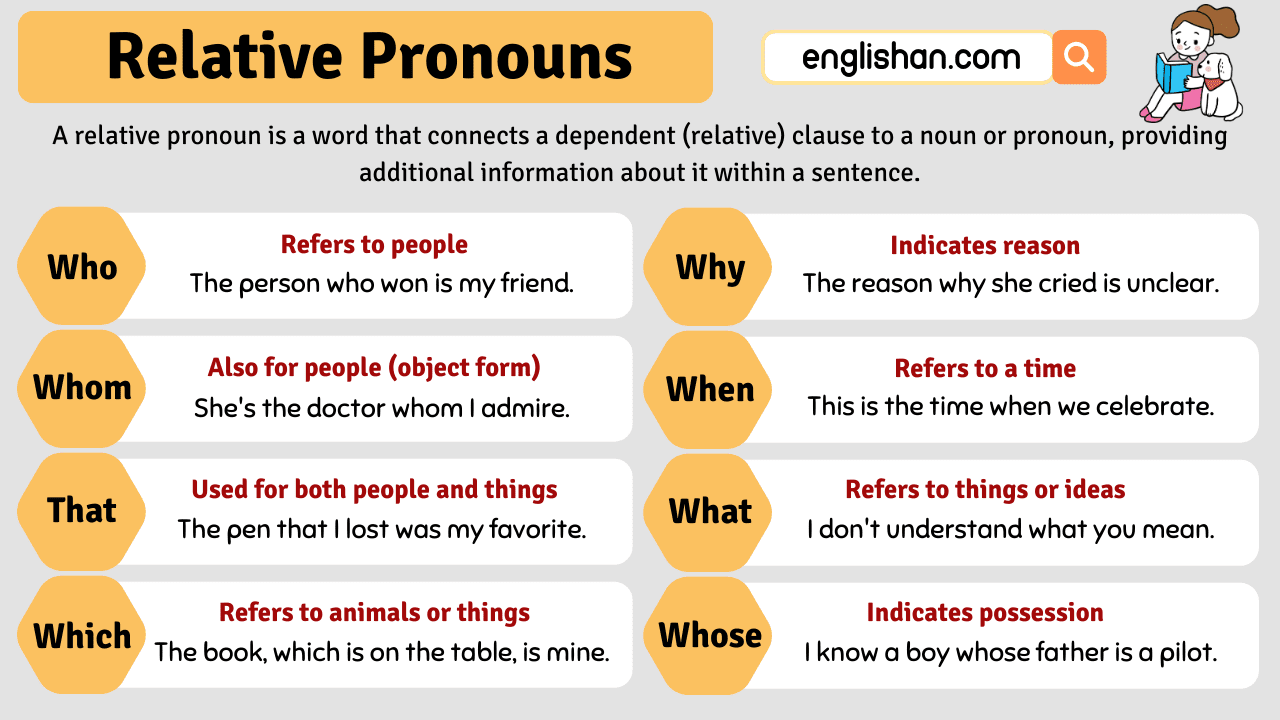
A relative pronoun introduces a relative clause and refers back to a noun or pronoun that came earlier in the sentence. The most common examples include who, whom, whose, which, and that, while where and when sometimes function in a similar relational way. These words act as a bridge, attaching extra information to a main noun without starting a new sentence, which keeps your ideas flowing smoothly. Using them well improves clarity, reduces repetition, and adds sophistication to both written and spoken language.
From a structural point of view, the relative pronoun has two roles at once: it connects clauses, and it stands in for a noun or noun phrase inside the relative clause itself. For example, in the sentence The author who wrote that novel lives next door, the word who links author to the clause wrote that novel and also serves as the subject of that clause. Recognizing this dual function makes it easier to choose the right relative pronoun and to punctuate correctly, especially when you start mixing in commas, dashes, or parentheses for more expressive relative clauses.
The basic relative pronouns in everyday English
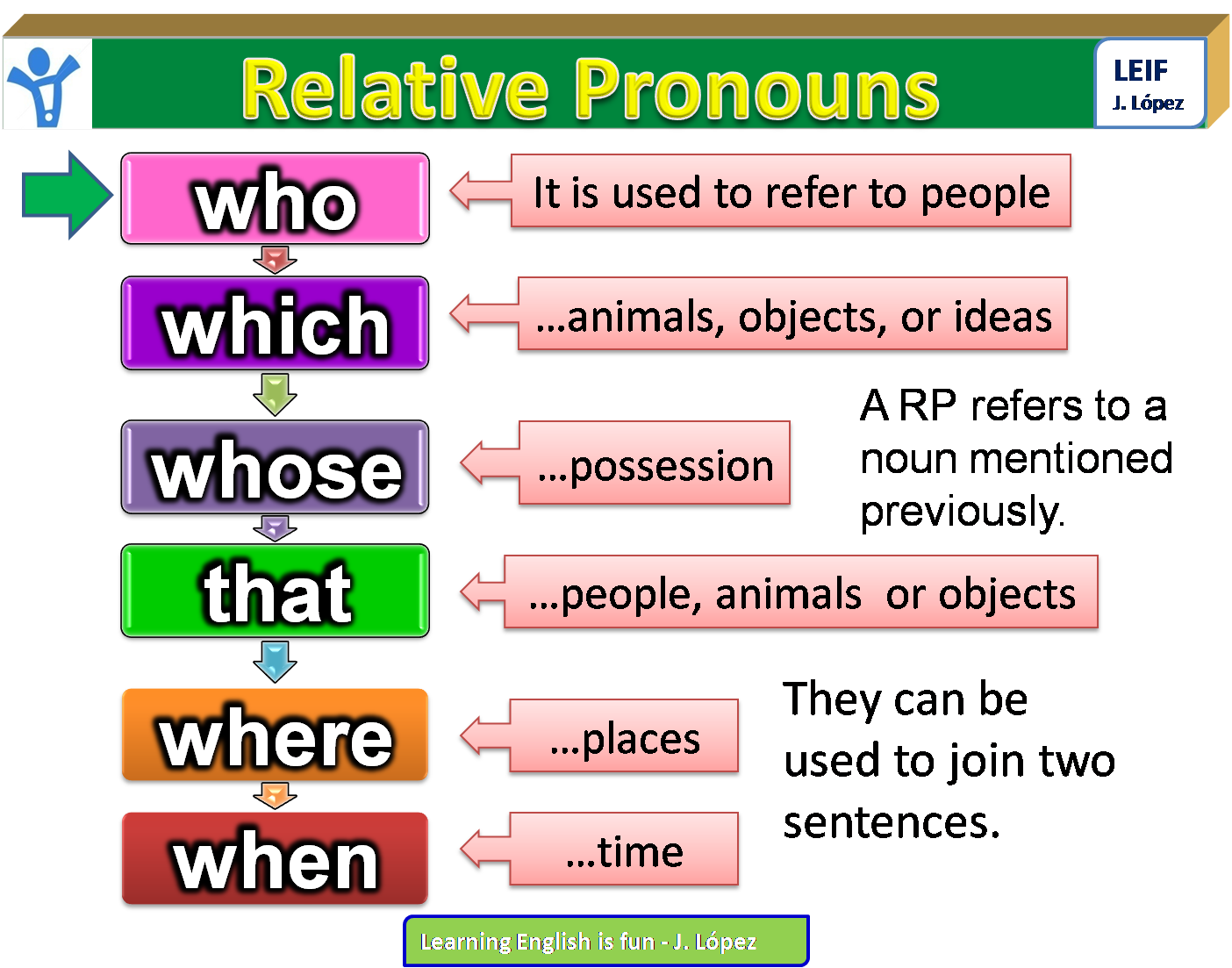
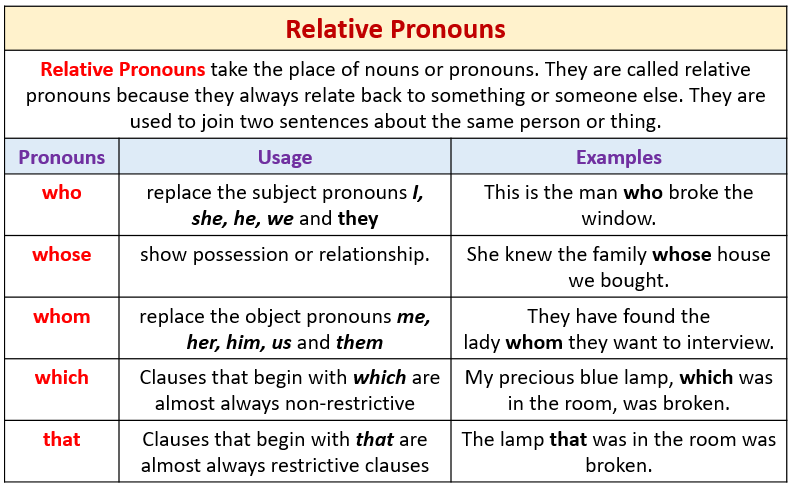
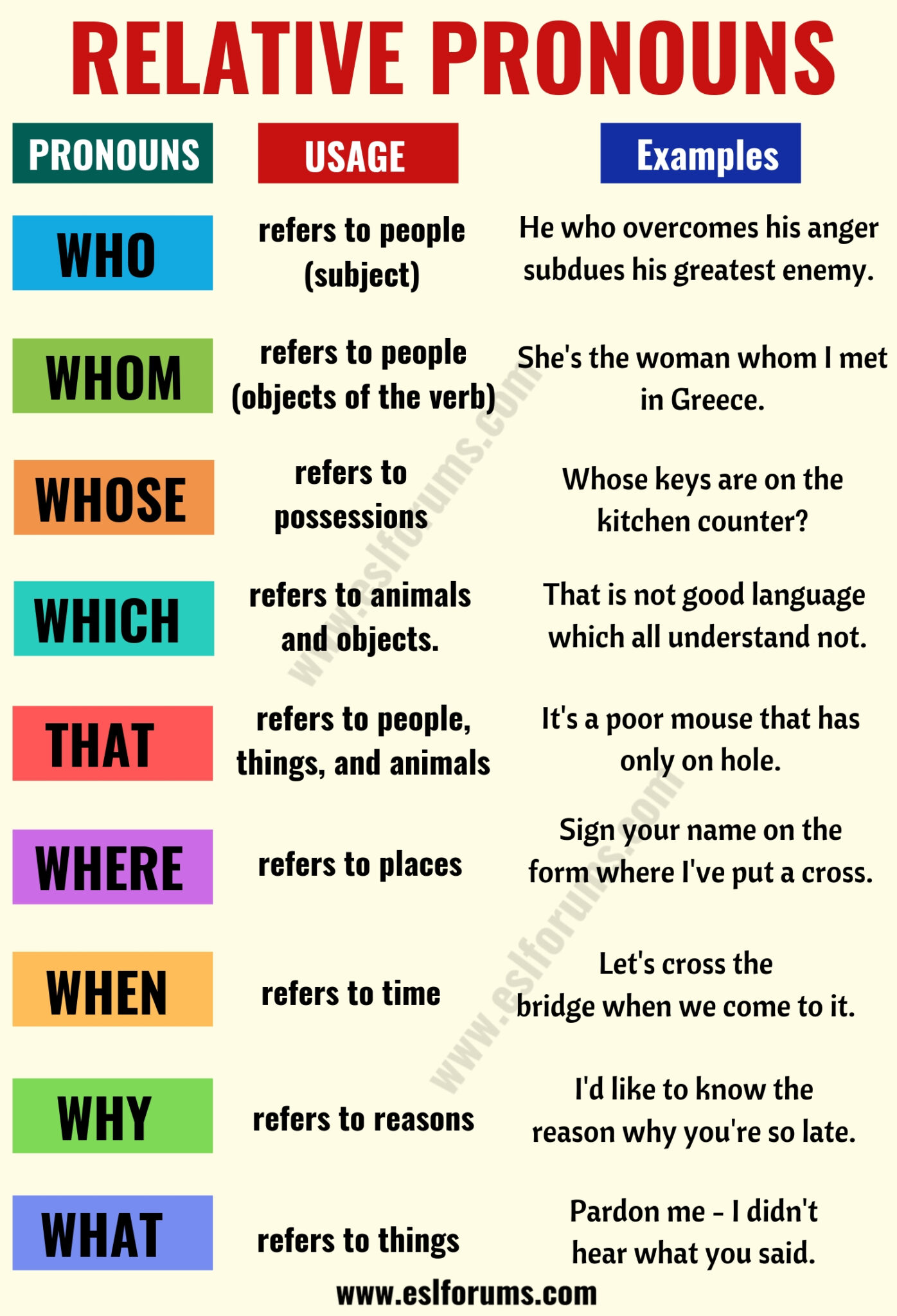
In daily English, who and whom refer to people, which typically refers to things or animals, and that can refer to people or things in more informal contexts. The possessive form whose works for people, animals, organizations, and even situations when you want to highlight possession within the relative clause. Pay attention to the role the pronoun plays inside the clause, because that determines whether you need who as a subject, whom as an object, or whose showing ownership.
Consider these patterns: The student who asked the question was very insightful (subject), The person whom I emailed replied at once (object), and The car whose alarm kept us awake all night finally got fixed (possession). With things, you might say The report which arrived late caused confusion or The device that saves energy is popular now. By paying attention to whether the relative pronoun is doing the action, receiving the action, or showing possession, you can choose the form that sounds natural and remains grammatically solid.
When to use commas with relative clauses
Commas change the meaning of sentences with relative pronouns by signaling whether the clause is essential or non‑essential to the main point. A non‑essential clause, also called a non‑restrictive relative clause, adds extra detail that could be removed without destroying the core meaning, and it must be set off with commas, dashes, or parentheses. An essential, or restrictive, clause, on the other hand, is crucial for identifying which person or thing you mean, so it should not be separated by commas.

Compare these examples: My brother who lives in Berlin is visiting (no commas, essential information telling me which brother) versus My brother, who lives in Berlin, is visiting (with commas, already clear which brother, so the clause is just extra information). The same idea applies to things: The software that crashed yesterday is updated (essential) compared with The software, which crashed yesterday, needs a reboot (non‑essential). Mastering this distinction helps you write sentences that are both accurate and easy to follow.
Choosing between that and which
Many speakers and writers wonder when to use that and when to use which, and the answer largely depends on whether the clause is essential and on your stylistic preferences. In American English, it is common to use that for essential clauses and which for non‑essential clauses, especially when the sentence would benefit from a smoother, more formal rhythm. British English is often a bit more flexible, but the underlying logic remains the same: if the clause narrows down the noun and you would not want a comma before it, lean toward that; if the clause is extra description set off by commas, choose which.
Examples help illustrate this: The dress that you wore yesterday was stunning (essential, no commas) versus The dress, which you wore yesterday, is now in the laundry (non‑essential, with commas). In less formal writing, people sometimes use which even for essential clauses, but in precise or academic contexts it is often better to keep the traditional distinction. Deciding consciously between that and which sharpens your message and signals care to attentive readers.
Special cases with whose, where, and when
The relative pronoun whose can refer to people, animals, organizations, and sometimes inanimate objects when possession is involved, making it quite versatile. You might write The company whose profits doubled announced new hiring or The town whose streets are lined with oak trees feels timeless. Meanwhile, where introduces clauses that describe places, and when introduces clauses that refer to times, and both can appear with both essential and non‑essential structures. For instance, That is the lab where the experiments began (essential) and Last summer, when the power failed, was unforgettable (non‑essential).
- Use whose for possession with people, animals, or things.
- Use where for places, and make sure the location is clearly implied in the main clause.
- Use when for times, dates, seasons, or periods, again ensuring the reference is clear.
These choices are not just about strict rules; they are about guiding your reader smoothly from one idea to the next. When you experiment with whose, where, and when in relative clauses, you add variety and precision, which keeps your prose lively and professional. The more you notice how these pronouns appear in the texts you read, the more naturally they will appear in your own writing.
Common mistakes and how to avoid them
One frequent error is leaving out a necessary relative pronoun, which can make a sentence confusing or ambiguous. For example, saying The manager explained the policy yesterday leaves it unclear whether the policy or the manager appeared yesterday, while The manager who explained the policy yesterday fixes the meaning. Another issue is mixing up who and whom, especially in questions or after prepositions, so it helps to test the sentence by converting the relative clause into a standalone question and seeing whether you would say he or him. Awkward constructions can often be simplified by switching from whom to who in informal contexts, as long as the meaning stays clear.
Overusing that or stacking too many clauses with which can make your writing feel heavy or tangled, so it is useful to vary sentence length and structure. Try breaking a long, dense sentence into two shorter ones or choosing a more specific relative pronoun to reduce friction. Reading your work aloud is one of the simplest ways to spot clunky relative clauses, because your ear will often catch what your eye skips. With practice, choosing and placing relative pronouns becomes an intuitive part of crafting clear, engaging sentences.
Improving your use of relative pronouns through practice
You can strengthen your command of relative pronouns by revising your own writing and paying attention to how skilled writers use them in articles, stories, and professional emails. Look for sentences where a comma appears just before a relative pronoun and ask whether that clause really is non‑essential, or whether the whole sentence would be clearer with a different structure. Rewriting a paragraph to replace vague repetition with who, which, or whose can instantly increase precision and flow. Even small adjustments, such as choosing that instead of which in an essential clause, can sharpen your message.
As you experiment with these tools, remember that the goal is not to impress people with complicated grammar but to communicate your ideas as clearly and smoothly as possible. Relative pronouns are like connectors on a chain: each one should link parts of your sentence in a way that feels natural and purposeful. The more you notice their role in the sentences you read and write, the more confidently you will be able to use relative pronouns to build sentences that are correct, vivid, and memorable.
Conclusion
Relative pronouns are small words with a big impact, shaping how ideas relate to one another and how easily readers follow your logic. By understanding the roles of who, whom, whose, which, that, where, and when, and by paying attention to essentials like commas and clarity, you can make your writing more precise and engaging. Keep practicing, notice how these pronouns work in context, and soon you will use them naturally to create sentences that are both correct and expressive.
Relative Pronouns | Learn Basic English
In this Learn Basic English episode we learn how to correctly use relative pronouns! Audio hardware: Yeti Blue microphone Audio ...
